




|
|
|
|
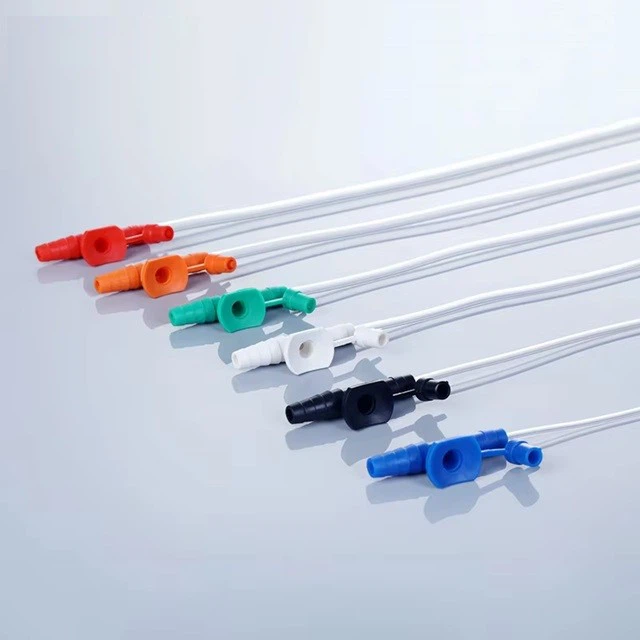
Disposable Suction Catheter1. Disposable suction catheter kit is used to suck the sputum and secretion in respiratory tract.
2. Color coded connector for easy identification of size.3. Atraumatic rounded closed tip with two or four lateral eyes. 4. Store under shady, cool, dry, ventilated and clean condition. Specification:
Product name: Disposable suction catheter
Material: Medical grade PVC
Catheter type: T-type connector, with valve connector
Sterile: EO gas sterile or not as request
Expiry date: 5 years
|

"PVC Suction Catheter" refers to a polyvinyl chloride suction catheter. The following is a detailed introduction about it:
Structural Composition
Catheter Body: It is made of polyvinyl chloride (PVC) material. The catheter body has a certain degree of flexibility and moderate hardness. The flexibility enables it to pass smoothly through the curved parts of the human airway and other areas, while the moderate hardness helps medical staff better control the direction of the suction catheter during operation. The catheter body comes in various diameters. Suction catheters with thinner diameters are suitable for children or patients with narrower airways, while those with thicker diameters can be used when a large amount of sputum or secretions need to be quickly sucked out. The lengths of the catheter bodies also vary. Common lengths can meet the needs of inserting through the oral cavity or nasal cavity to different depths of the airway for sputum suction operations.
Tip: The tip of the suction catheter is designed to be relatively round and smooth, which can reduce damage to the airway mucosa when inserted into the airway. Some tips may also have special shapes or structures, such as a beveled cut surface, etc., to better adapt to the anatomical structure of the airway and improve the efficiency of sputum suction.
Side Holes: There are multiple side holes distributed on the catheter body. These side holes are the channels through which sputum and secretions enter the suction catheter. The number, size, and distribution positions of the side holes are carefully designed. A reasonable design of the side holes can ensure that during the sputum suction process, the sputum can be evenly sucked into the tube, and at the same time, avoid unsmooth sputum suction or unnecessary irritation to the airway mucosa caused by the side holes being too large or too small or having an unreasonable distribution.
Connector: One end of the suction catheter is usually equipped with a connector, which is used to connect with the suction device (such as a suction machine). The design of the connector should ensure a tight connection with the suction device to prevent air leakage during the sputum suction process, so as to ensure that the negative pressure of suction can be effectively transmitted to the front end of the suction catheter and achieve efficient sputum suction.
Functional Roles
Removing Airway Secretions: Its main function is to remove substances such as sputum and secretions in the patient's airway. When the patient has sputum accumulation in the airway due to various reasons (such as lung infection, after surgery, neurological diseases, etc.) and the respiratory function is affected, the polyvinyl chloride suction catheter can be inserted into the airway through the oral cavity or nasal cavity. Using the negative pressure generated by the suction device, the sputum and secretions are sucked out, thus keeping the airway unobstructed and improving the patient's respiratory condition.
Preventing Respiratory Tract Infections: Timely removal of secretions in the airway helps to reduce the growth and reproduction of pathogens such as bacteria in the airway and reduces the risk of respiratory tract infections. Especially for some patients who are bedridden for a long time, in a coma, or have low immunity, regular sputum suction is one of the important measures to prevent respiratory tract infections.
Auxiliary Treatment: In some treatment processes, such as the nursing after tracheotomy and the airway management of patients on mechanical ventilation, the suction catheter also plays an important auxiliary role. It can help medical staff promptly remove the secretions in the airway, ensure the cleanliness of the airway, and create good conditions for the patient's treatment and recovery.
Characteristics
Lower Cost: The polyvinyl chloride (PVC) material has a relatively low cost, making the PVC suction catheter an affordable choice in situations where medical resources are limited, and it can meet the basic sputum suction needs of a large number of patients.
Easy to Operate: Its moderate hardness and flexibility make the suction catheter relatively easy to control during insertion and operation. Medical staff can accurately insert the suction catheter into the area where sputum needs to be suctioned. At the same time, the connection between the connector and the suction device is also convenient, and the operation is simple and quick.
Strong Processability: The PVC material is easy to process and form, and suction catheters of various specifications and shapes can be made according to different clinical needs. For example, scale markings can be added to the catheter body to facilitate medical staff to master the insertion depth; the catheter body can also be specially treated to improve its antibacterial performance, etc.
Classification
Classification by Diameter: It can be divided into suction catheters of different diameters, such as No. 6, No. 8, No. 10, etc., to adapt to the airway conditions of different patients and the needs of sputum suction. Selecting the appropriate diameter is very important for ensuring the sputum suction effect and the comfort of the patient.
Classification by Length: According to different lengths, suction catheters can be divided into short-length, medium-length, and long-length types. Short-length suction catheters are suitable for shallow sputum suction from the oral cavity or nasal cavity, while medium-length and long-length suction catheters can be used for deep sputum suction operations in the airway.
Classification by Function: There are ordinary suction catheters and suction catheters with special functions. For example, a suction catheter with a side hole regulating valve can adjust the opening and closing degree of the side holes as needed during the sputum suction process, thus controlling the magnitude of the negative pressure of suction and reducing damage to the airway mucosa; some suction catheters are coated with an antibacterial layer, which can reduce the risk of bacterial infection during the sputum suction process.
Related Precautions
Aseptic Operation: When using a PVC suction catheter, the principle of aseptic operation must be strictly followed to prevent the occurrence of respiratory tract infections. Medical staff should wear sterile gloves, masks, and hats, use sterile suction catheters and related equipment, and strictly disinfect the patient's oral cavity, nasal cavity, and other parts.
Proper Insertion: When inserting the suction catheter, the movement should be gentle to avoid excessive force, so as not to damage the airway mucosa. At the same time, select the appropriate insertion route (oral cavity or nasal cavity) and insertion depth according to the specific situation of the patient to ensure that the suction catheter can accurately reach the area where sputum accumulates.
Controlling Suction Negative Pressure: The magnitude of the suction negative pressure should be appropriately adjusted according to the patient's age, condition, and airway situation. Excessive negative pressure may cause damage and bleeding to the airway mucosa, while too low negative pressure may affect the sputum suction effect. Generally, the suction negative pressure for adults can be controlled at 150-200 mmHg, and the suction negative pressure for children should be appropriately reduced.
Sputum Suction Time and Frequency: The time for each sputum suction should not be too long, generally not exceeding 15 seconds, to avoid causing hypoxia in the patient. The frequency of sputum suction should be determined according to the patient's sputum secretion situation. Too frequent sputum suction may stimulate the airway mucosa and lead to an increase in sputum secretion.
Treatment of the Suction Catheter: The used suction catheter should be properly disposed of according to the regulations for medical waste treatment. Disposable suction catheters should not be reused to prevent cross-infection. For reusable suction catheters, strict cleaning, disinfection, and sterilization treatments must be carried out before they can be used again.
Hot Tags: pvc suction catheter, China pvc suction catheter manufacturers, suppliers, factory


